SolisAI Overview and Configuration Guide
Overview
SolisAI is an intelligent energy management platform integrated within SolisCloud that automatically optimizes battery charging, battery discharging, energy imports, and energy exports based on electricity tariffs, weather forecasts, household consumption patterns, and system operating constraints. The goal is to help users maximize self-consumption, reduce electricity costs, increase energy revenue, and optimize battery utilization.
For detailed settings, visual walkthroughs, and configuration examples, please refer to the attached PDF
Key Features of SolisAI
SolisAI continuously analyzes multiple data sources to make intelligent energy management decisions.
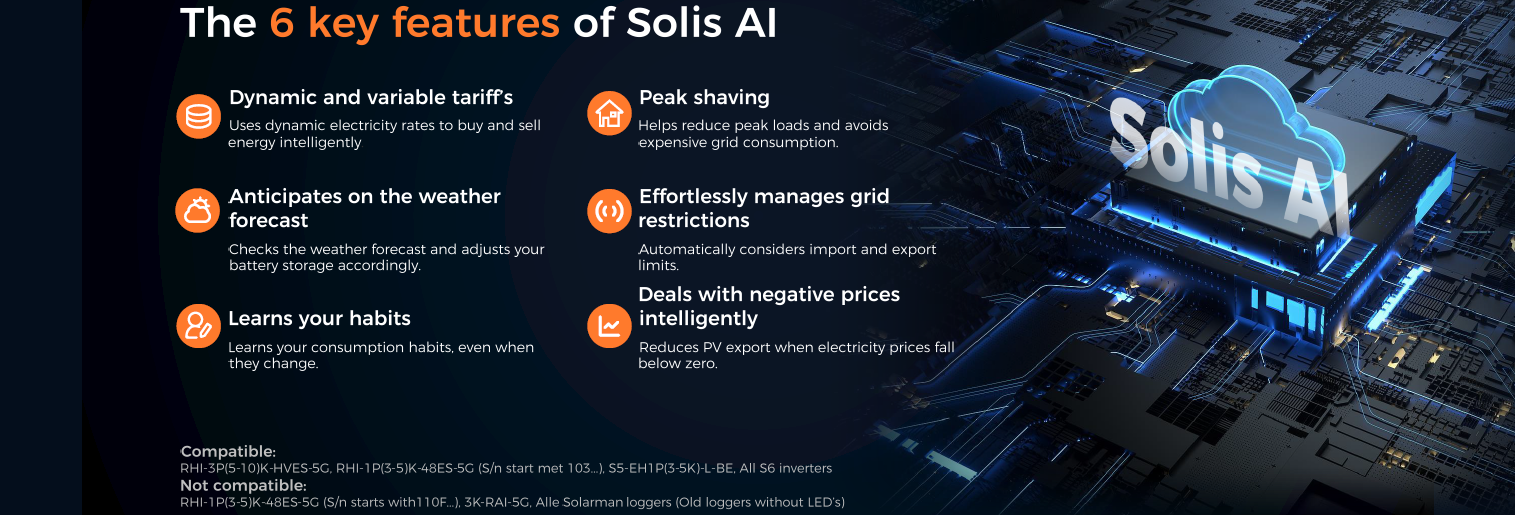 Dynamic Electricity Tariff Optimization
SolisAI can use dynamic electricity pricing information to automatically determine the most cost-effective times to charge batteries from the grid and export energy back to the grid. More info on SolisAI Tariff Configuration Guide
Weather Forecast Integration
The system reviews weather forecasts and adjusts battery charging and storage strategies accordingly to maximize the value of available solar generation.
Consumption Learning
SolisAI learns household energy consumption habits and continuously adapts as usage patterns change over time.
Peak Shaving
Peak shaving functionality helps reduce grid import peaks, minimizing demand-related charges and helping to avoid unnecessary high grid consumption during expensive periods.
Grid Restriction Management
The system can automatically manage configured import and export limitations to ensure operation remains within customer or utility requirements.
Negative Price Handling
When electricity prices fall below zero, Solis AI can intelligently reduce export activity to avoid unfavorable energy transactions.
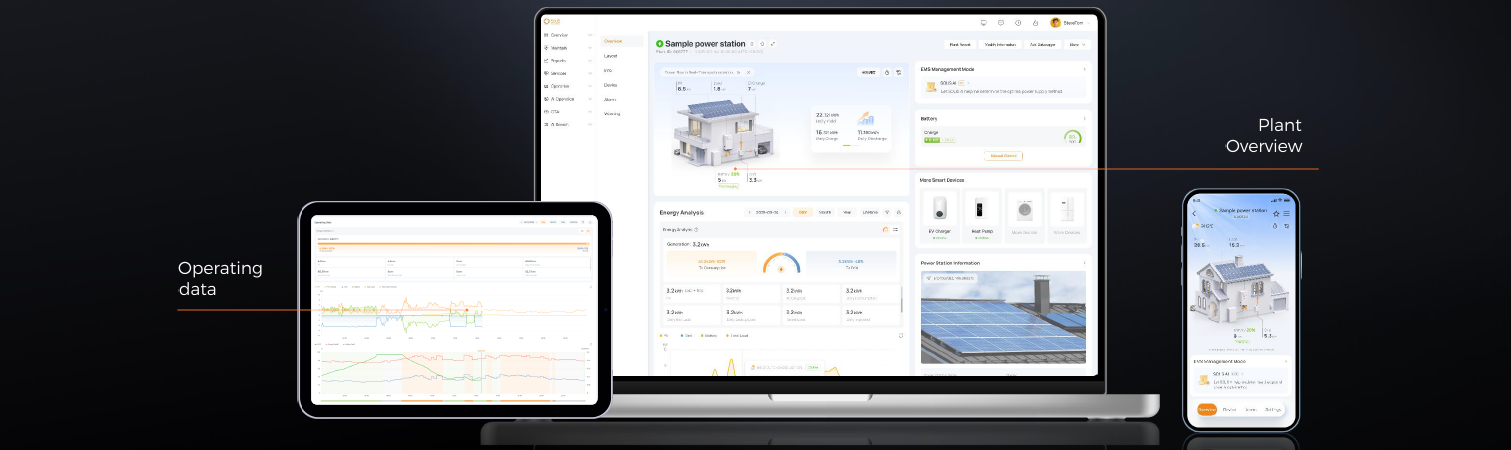
Solis AI Dashboard in SolisCloud
The Solis AI dashboard provides access to:
- Energy statistics
- Daily energy flow analysis
- Event review and forecasting
- Plant overview
- Real-time operating data
Screenshot example:
Compatible Products
Supported Inverters
SolisAI currently supports:
- RHI-3P(5-10)K-HVES-5G
- RHI-1P(3-5)K-48ES-5G (Serial numbers beginning with 103...)
- S5-EH1P(3-6)K-L
- All S6 Hybrid inverter models
Unsupported Inverters
SolisAI is not compatible with:
- RHI-1P(3-5)K-48ES-5G (Serial numbers beginning with 110F...)
- 3K-RAI-5G
- Legacy Solarman data loggers without LED indicators
Solis AI Operating Modes
Users can select from three operating strategies depending on their energy goals.
Self-Use Mode
Prioritizes self-consumption of solar-generated energy and battery-stored energy to reduce grid dependence.
Balanced Mode
Combines self-consumption and energy arbitrage. The system charges and discharges the battery when sufficient pricing differences exist between low-cost and high-cost periods.
Maximize Revenue Mode
Focuses on purchasing and exporting electricity based primarily on revenue-generating opportunities available through the selected tariff structure. 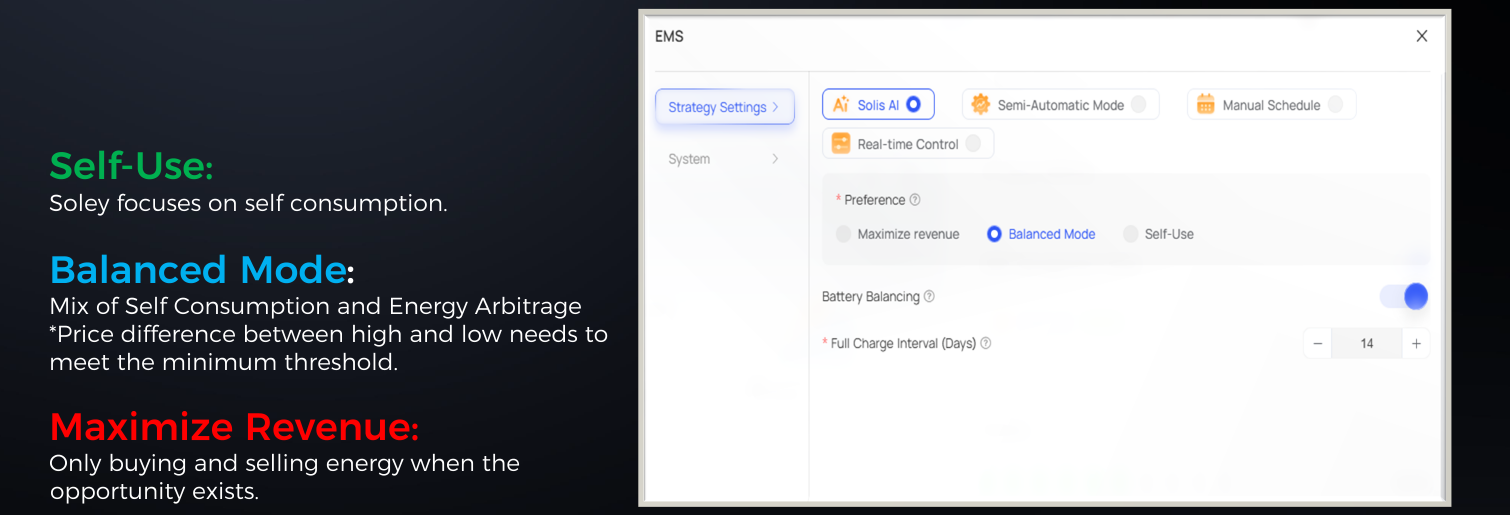
Battery Settings
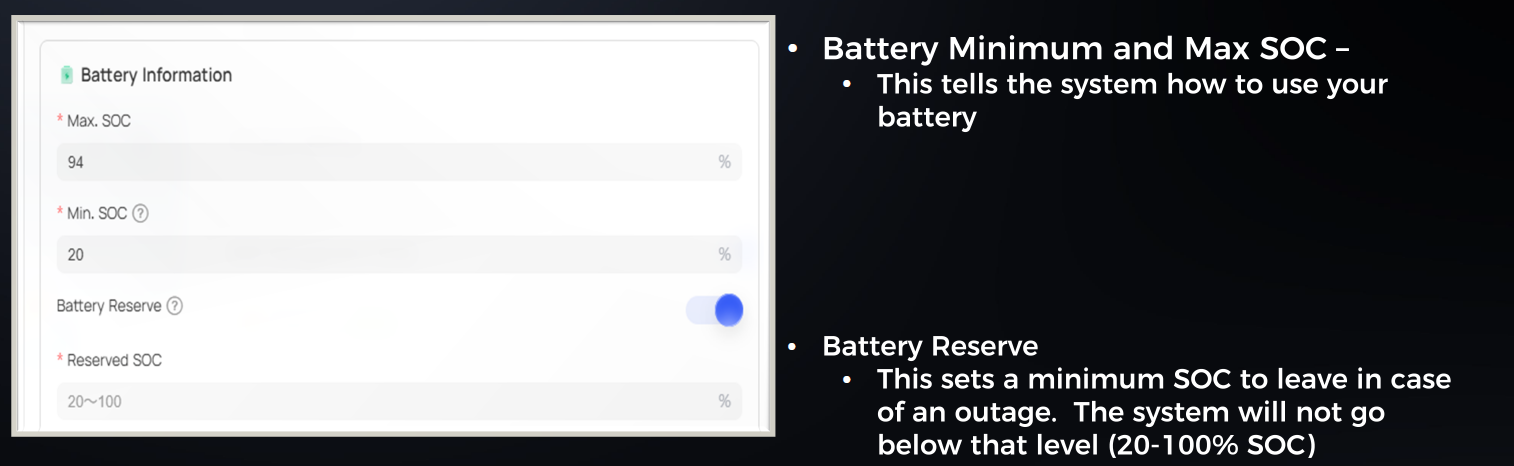
Battery Minimum and Maximum SOC
Minimum and maximum State of Charge (SOC) settings define the operational battery range that Solis AI may utilize during normal operation.
Battery Reserve
The Battery Reserve setting ensures a defined amount of battery capacity remains available for backup power during outages.
Available range:
- 20% to 100% SOC
The system will not discharge below the configured reserve level.
Peak Shaving Configuration
Peak shaving can be enabled to control grid imports during periods of high consumption.
When activated:
- SolisAI monitors site consumption
- The battery assists during demand peaks
- Peak demand charges can be reduced
- Grid import spikes can be limited
The Peak SOC setting reserves part of the battery specifically for peak shaving functionality.

Import and Export Power Limits
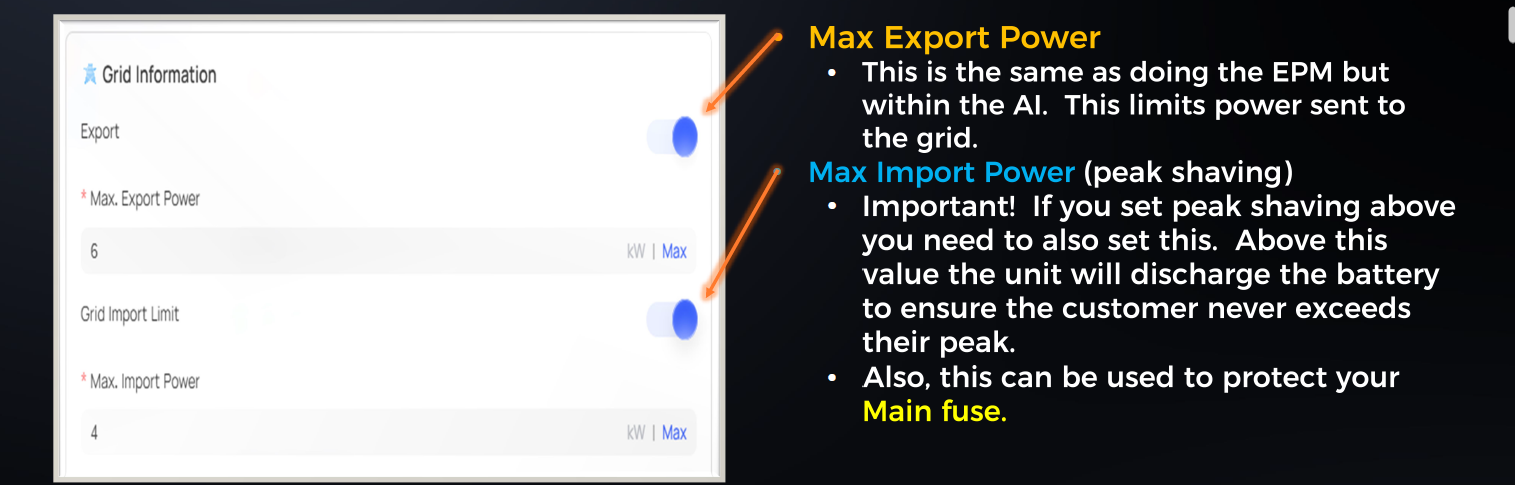
Maximum Export Power
The Maximum Export Power setting limits the amount of power exported to the utility grid and can be used similarly to traditional export limitation solutions.
Maximum Import Power
The Maximum Import Power setting works together with peak shaving.
When grid consumption exceeds the configured limit:
- The battery will discharge automatically
- Grid imports remain below the configured threshold
- Main fuse protection can be improved
TOU (Time-of-Use) Grid Limits
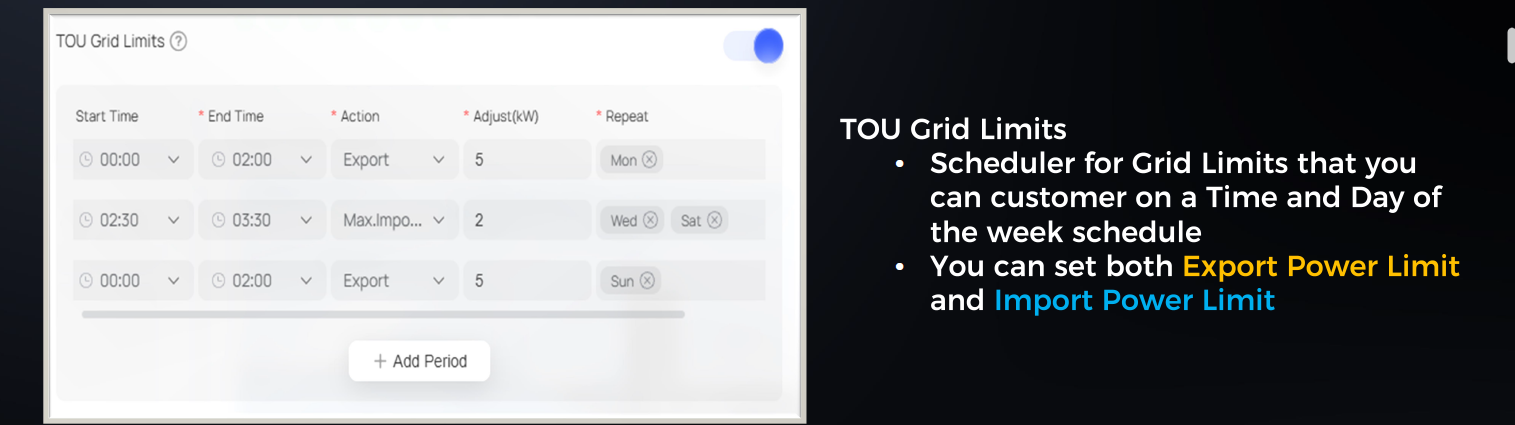
SolisAI supports scheduling import and export limits based on:
- Time of day
- Day of week
This allows users to configure different limits depending on utility requirements, local grid regulations, or site-specific operating strategies.
Battery Cycle Cost
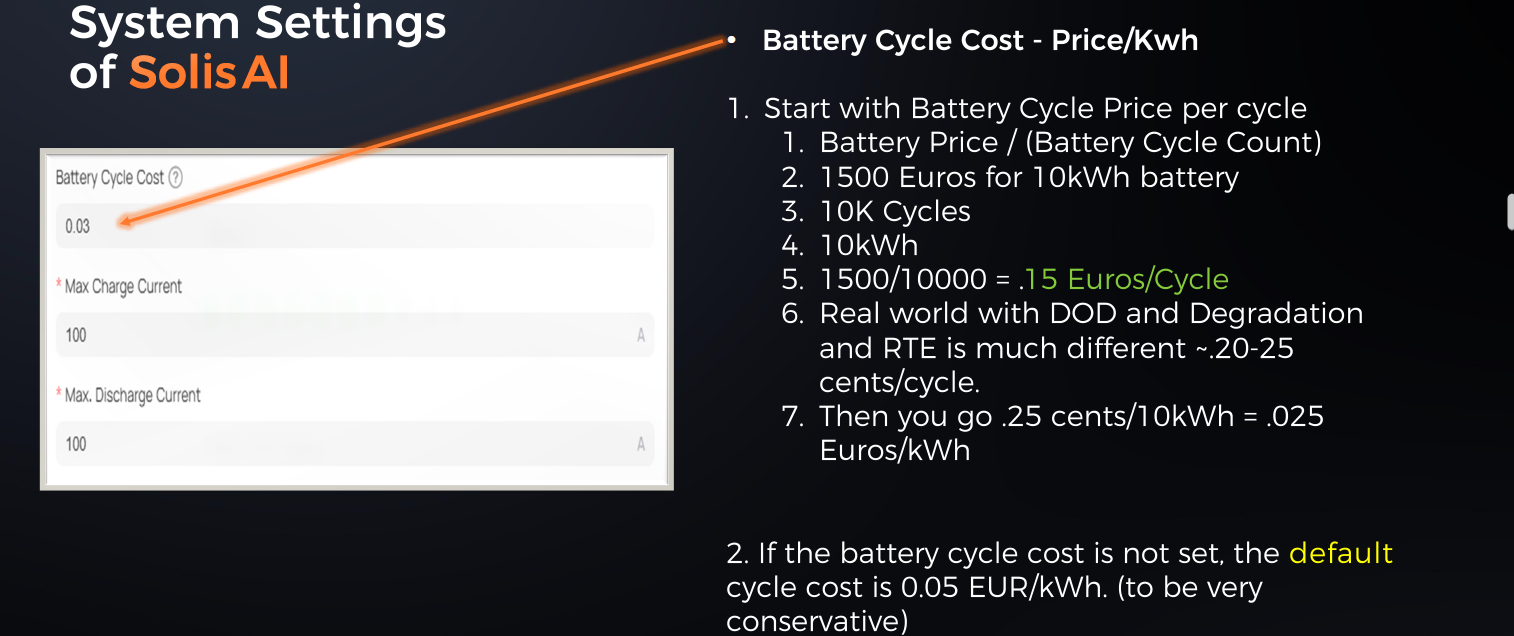
Battery degradation has a cost associated with each charging and discharging cycle.
SolisAI allows users to configure battery cycle costs so that charging and discharging decisions better reflect actual battery economics.
Example Calculation
Battery Cost: €1,500
Battery Capacity: 10 kWh
Expected Lifetime: 10,000 Cycles
Cycle Cost:
€1,500 / 10,000 = €0.15 per cycle
Considering battery degradation, depth of discharge (DoD), and round-trip efficiency losses, the real-world cost may be closer to €0.20-€0.25 per cycle.
If no value is configured, Solis AI uses a default battery cycle cost of €0.05/kWh.
Tariff Configuration
To fully optimize battery operation and energy costs, Solis AI requires accurate electricity tariff information. By understanding when electricity prices are low or high, SolisAI can automatically choose the best times to charge, discharge, import, or export energy, helping to maximize self-consumption, reduce energy costs, and increase potential export revenue.
Solis AI supports multiple tariff types, including:
- Fixed Tariffs where electricity prices remain constant throughout the day.
- Static Time-of-Use (TOU) Tariffs with predefined peak and off-peak rates.
- Dynamic Tariffs where electricity prices vary based on wholesale energy markets or utility pricing.
For countries and utilities that support dynamic pricing, Solis AI can automatically retrieve tariff information, allowing the system to continuously adapt battery charging and discharging strategies based on real-time or forecasted energy prices.
To achieve optimal performance, both import tariffs (electricity purchase costs) and feed-in tariffs (export compensation rates) should be configured correctly. This enables Solis AI to make intelligent decisions that balance self-consumption, battery preservation, and export opportunities.
For detailed tariff setup instructions, supported countries, available tariff providers, and configuration examples, please refer to the"SolisAI Tariff Configuration Guide"
Forecasting and Energy Optimization
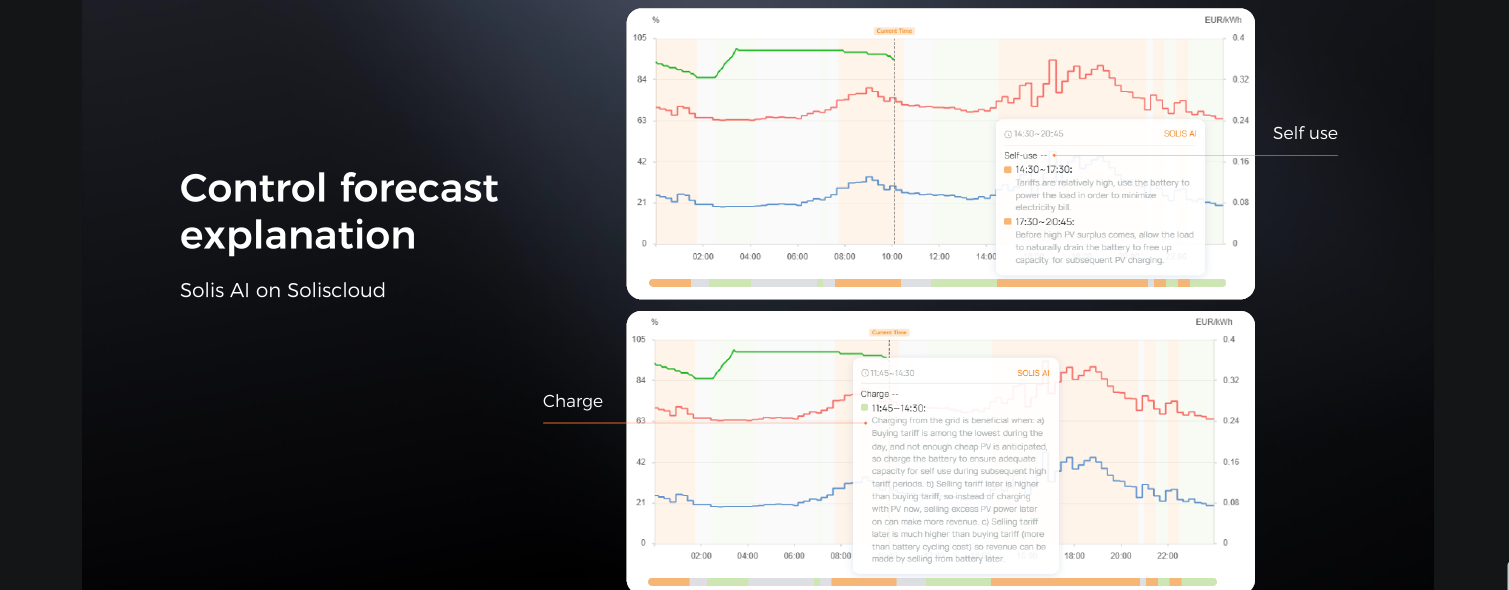
Solis AI uses forecast information to determine when battery energy should be:
- Stored
- Consumed
- Imported
- Exported
The system continuously balances self-consumption objectives against tariff opportunities and forecasted solar production.
Example Benefits
A real-world example shown in Solis AI demonstrates:
- €5.80 revenue earned in a single day through optimized exports
- €81 revenue generated in one month
- 675 kWh exported to the grid
- 600 kWh supplied to EV charging
- Controlled peak demand of 3.7 kW
Actual results will vary depending on tariffs, battery capacity, local regulations, and energy consumption patterns.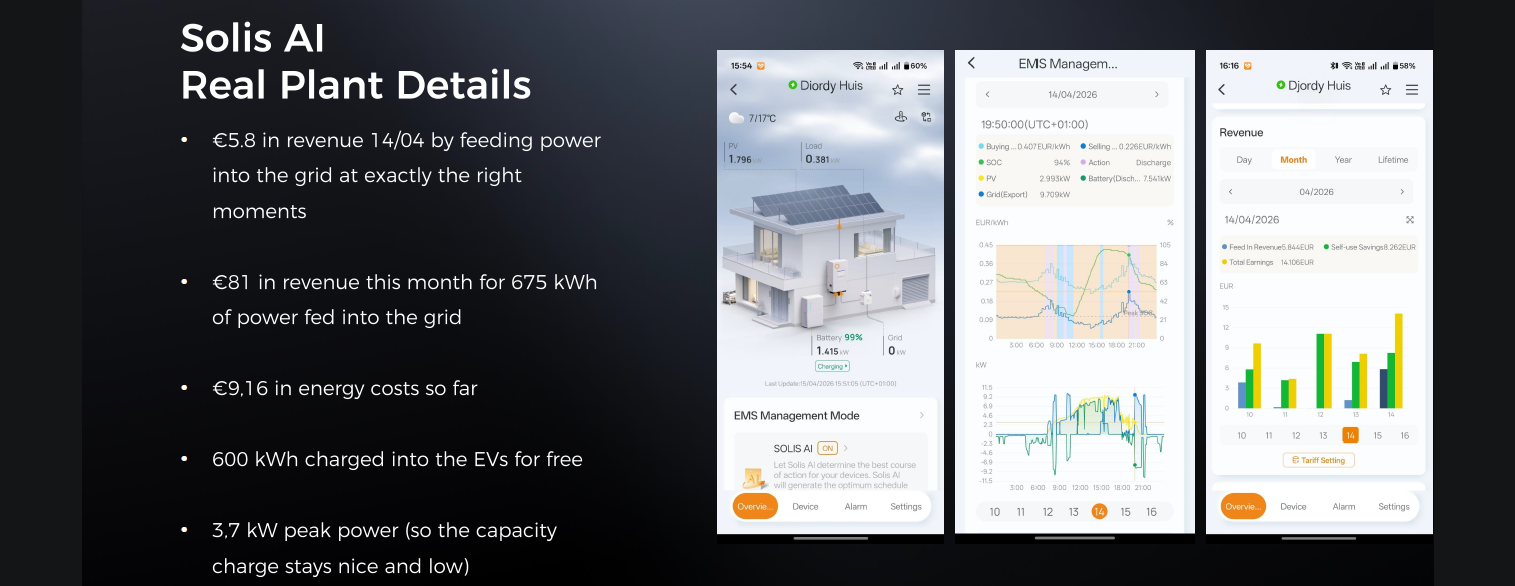
Future Developments
Planned SolisAI enhancements include:
- Third-party heat pump integration via Enode
- Wider European retail tariff automation
- Automatic peak detection
- Solis EV charger integration
- Third-party EV charger integration via Enode
These planned features are subject to future software releases.
Disclaimer
The information provided in this article is intended for guidance purposes only and should be used in conjunction with the latest Solis product documentation, installation manuals, and applicable local regulations.
Solis strongly recommends that all installation, maintenance, and electrical work is carried out by a qualified and licensed electrician or suitably trained professional in accordance with local laws, regulations, and safety requirements.
While every effort is made to ensure the accuracy of the information provided, content may be updated without notice as products, firmware, standards, and regulations evolve. The information contained within this article does not replace official product documentation or professional judgement.
Site-specific requirements, local regulations, utility requirements, and applicable standards may vary and always take precedence. If you are unsure whether a particular installation, configuration, or application is supported, please contact Solis Technical Support before proceeding.