

Whole-Home Backup Topology Using EPS and ATS
Overview
Many modern Solis hybrid inverters support backup power functionality through a dedicated EPS (Emergency Power Supply) output and can be integrated with an Automatic Transfer Switch (ATS) for whole-home backup applications. This architecture allows automatic switching between the inverter backup supply and the utility grid while maintaining continuity of power to building loads
This article describes the recommended topology for Solis hybrid inverters that support EPS and ATS-based backup operation.
Applicable Solis Inverter Series
This topology is generally applicable to the following Solis hybrid inverter families:
Single-Phase Hybrid Inverters
- S6-EH1P-L-PLUS Series
- S6-EH1P-H Series
Three-Phase Hybrid Inverters
- S6-EH3P-LV Series
- S6-EH3P-H Series
- S6-EH3P-ND Series
These inverter families provide dedicated backup functionality via an EPS output and support ATS-based backup architectures. Always verify the installation manual for the exact inverter model before installation.
Understanding the Components
Grid Port
The Grid Port connects the inverter to the utility network and enables:
- Import of energy from the grid
- Export of excess PV energy
- Grid-assisted battery charging where permitted
EPS (Backup) Port
The EPS output is energized during grid outages and supplies backup loads using available solar generation and battery storage.
ATS (Automatic Transfer Switch)
The ATS is external equipment that automatically transfers loads between:
- The Solis inverter EPS output
- The utility grid supply
The ATS ensures that loads remain supplied if the inverter becomes unavailable due to maintenance, firmware updates, alarms, or faults.
Important: The ATS terminals on Solis inverters are signaling interfaces and do not replace an external power transfer switch. A dedicated ATS is still required for automatic load transfer.
Recommended Whole-Home Backup Topology
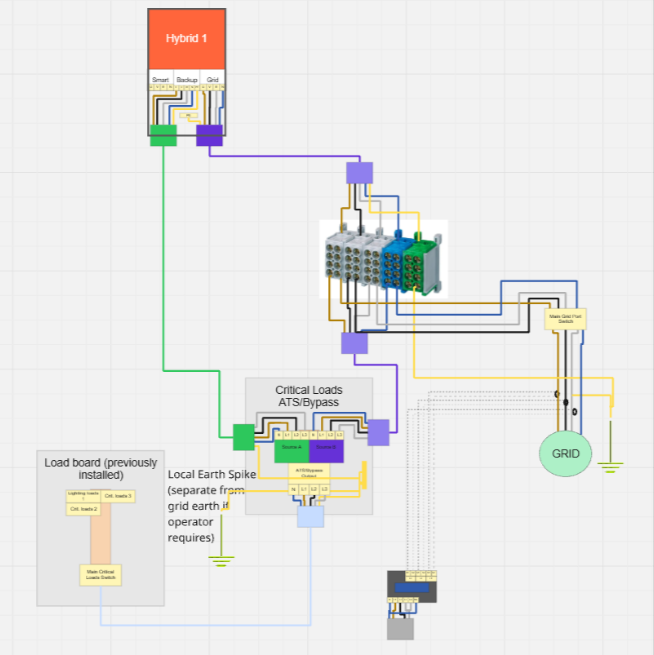
Operating Principle
Normal Operation
Under normal conditions:
- The inverter manages PV production, battery storage, and grid interaction.
- Loads are supplied from solar, battery, and grid according to system settings.
- The ATS monitors the available power sources and maintains the selected operating state.
Utility Grid Failure
When the grid becomes unavailable:
- The inverter disconnects from the utility supply.
- The EPS output remains energized.
- Connected loads continue to operate using solar and battery energy.
- The ATS remains connected to the backup supply.
Inverter Fault or Shutdown
If the inverter is unavailable because of:
- Internal fault
- Firmware update
- Service work
- Emergency shutdown
the EPS output is lost.
The ATS detects the loss of backup power and automatically transfers the load back to the utility grid once grid power is available. This avoids manual intervention and maintains supply continuity.
Critical Load Backup vs Whole-Home Backup
Option 1 – Critical Load Panel
Advantages
- Lower battery storage requirement.
- Extended backup duration.
- Reduced risk of EPS overload.
- Simpler installation design.
Option 2 – Whole-Home Backup
Advantages
- Entire property remains operational during outages.
- No separation between essential and non-essential circuits.
- Improved customer experience during power interruptions.
Design Considerations
The installer must ensure that:
- Total load does not exceed EPS capacity.
- Battery capacity is appropriately sized.
- High-consumption appliances are assessed and managed.
Particular attention should be paid to:
- EV chargers
- Heat pumps
- Electric boilers
- Air-conditioning systems
- Electric cooking appliances
These loads can significantly affect backup duration and inverter loading.
Generator Integration
Many Solis S6 hybrid inverters also support generator integration.
In these applications:
- A generator may be connected according to Solis generator integration guidance.
- An ATS can transfer the supply between utility and generator.
- The inverter can receive ATS status signals.
- The inverter prevents unintended back-feeding into the generator while allowing battery charging from generator power where supported.
Applicability and Limitations
This topology should be applied only to Solis hybrid inverter models that provide:
- A dedicated EPS/Backup output.
- Backup operation functionality.
- Support for ATS-based installations where permitted by local regulations.
This topology is not applicable to standard Solis string inverters that do not provide EPS functionality, such as conventional grid-tied inverter ranges.
Best Practice Recommendations
Use a Critical Load Panel When:
- Backup is required only for essential circuits.
- Battery capacity is limited.
- Long backup duration is the priority.
- A simpler installation is preferred.
Use Whole-Home Backup with an ATS When:
- Full-property backup is required.
- The battery system is appropriately sized.
- Automatic source transfer is desired.
- Load management considerations have been addressed.
Key Takeaway
For Solis hybrid inverter families including the S6-EH1P-L-PLUS, S6-EH1P-H, S6-EH3P-LV, S6-EH3P-H, and S6-EH3P-ND series, the recommended whole-home backup architecture consists of the inverter's EPS output feeding an external ATS, which automatically transfers the installation between backup power and the utility grid. This provides a robust and scalable solution for residential and light commercial backup applications while maintaining continuity of supply during both grid outages and inverter-related interruptions.

Connect with Solis


